HoloCPR: Mixed Reality for Time-Critical Emergencies
A mixed reality system that provides real-time, hands-free CPR guidance through a HoloLens headset, helping untrained bystanders perform cardiopulmonary resuscitation correctly during emergencies.
The Problem
During an out-of-hospital cardiac arrest, every second counts. Medical personnel often take eight minutes or more to arrive on the scene, and the survival rate drops by 7–10% for every minute without resuscitation. Bystander-initiated CPR can double or even triple survival rates, yet only about a third of bystanders actually step in. Fear of causing further harm, panic, and uncertainty about the correct technique keep most people frozen, even those with prior training.
First-aid kits include manuals. Phones can pull up instructions. But these approaches all demand the same thing: that someone in the middle of a cardiac emergency split their attention between reading a screen and keeping a person alive. Hospitals face a similar challenge. Inspired by aviation checklists, they use step-by-step protocols in high-cognitive-load scenarios, but those checklists live on plastic sheets or separate apps, disconnected from the equipment and the patient.
We asked: what if the instructions lived where the action is? What if, instead of glancing at a tablet and then back at the patient, a rescuer could see exactly where to place their hands, overlaid directly on the person's chest?
Our Approach: A Google Maps for CPR
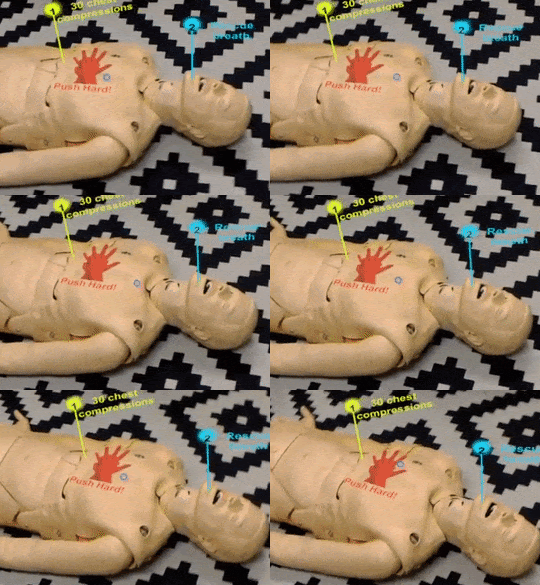
Similar to how mapping services turn drivers new to a city into navigation experts, we envisioned HoloCPR to increase bystanders' confidence in their ability to perform CPR during emergencies. The idea was simple: put a HoloCPR headset in a first-aid kit. During a cardiac arrest, the wearer looks at the victim, and the system immediately shows where to act, with steps revealed progressively, just like turn-by-turn navigation.
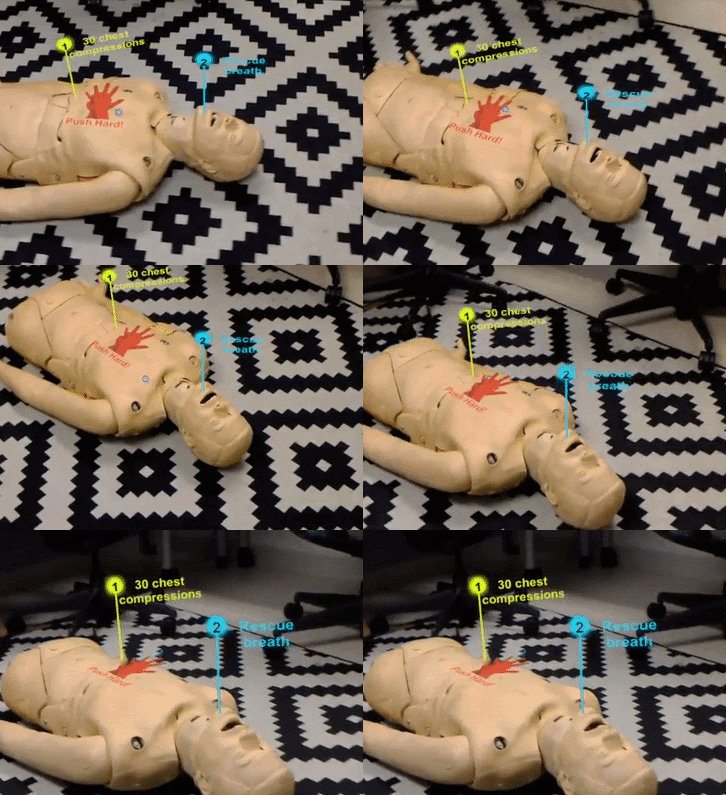
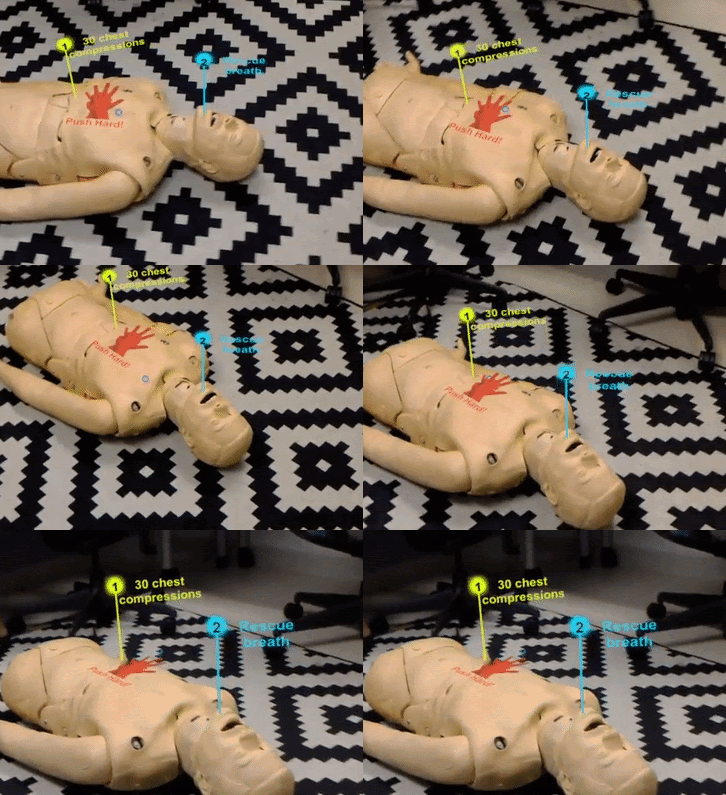
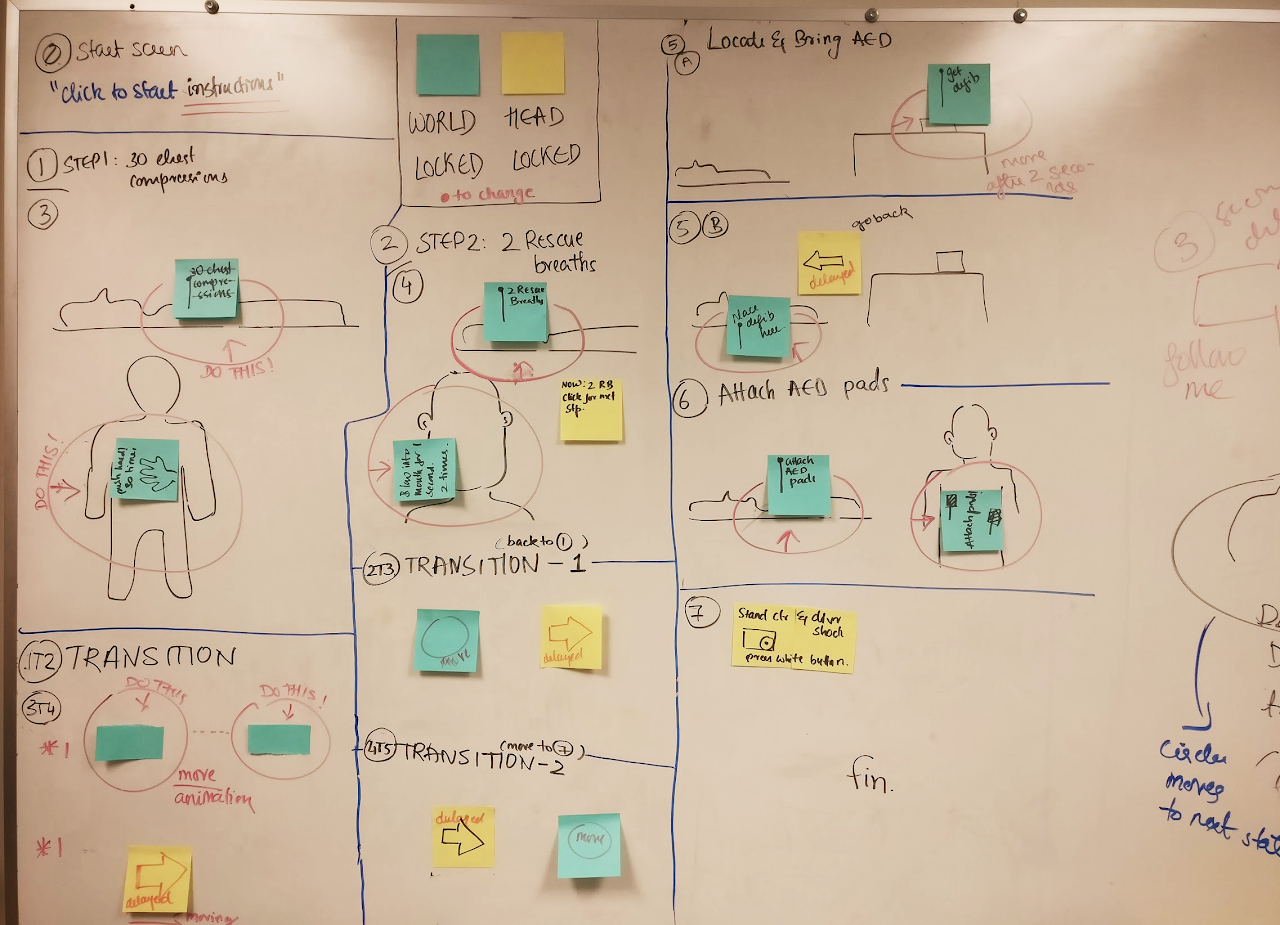
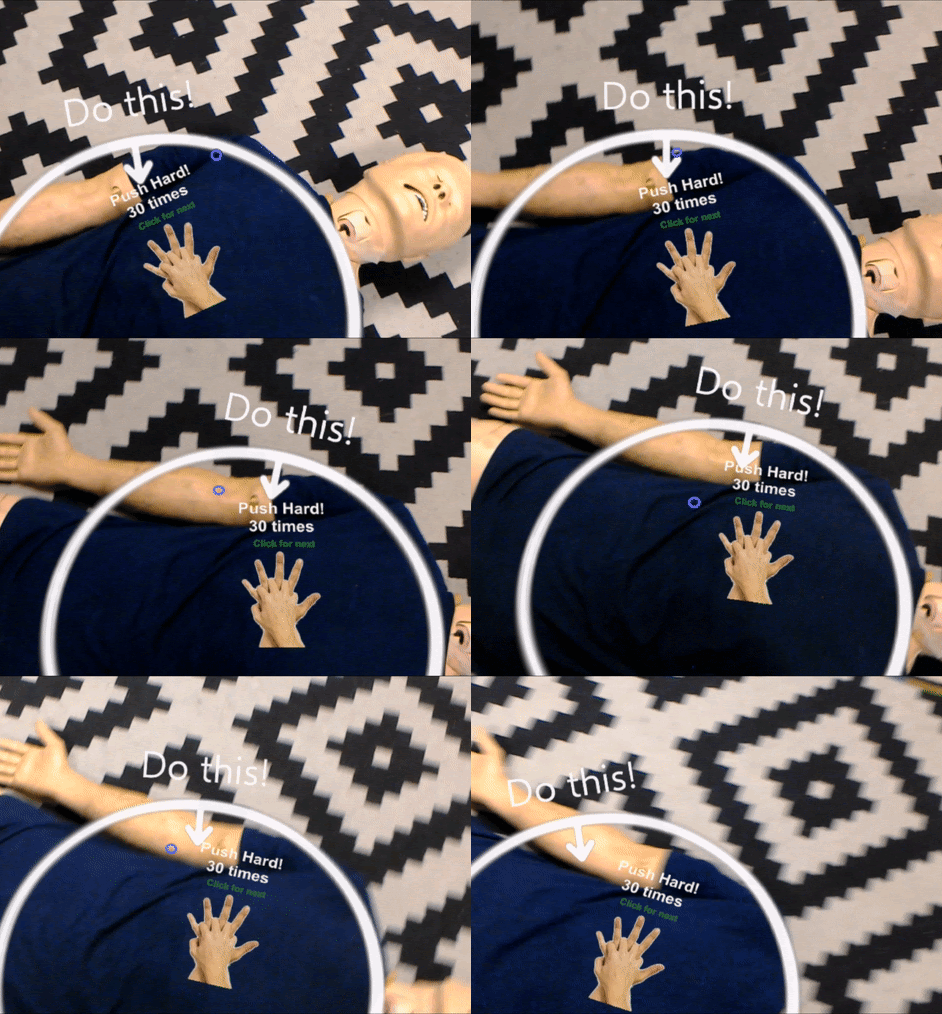
To build HoloCPR, we had to solve a fundamental design problem: how do you translate a paper checklist into spatial AR? We developed a framework that breaks every CPR instruction into three components: what to do, how to do it, and where to do it. On a paper checklist, all three are communicated through text and diagrams from a third-person perspective. In mixed reality, the where is given by the physical location of the hologram itself, and the how is shown from the rescuer's own first-person perspective. A chest compression instruction that takes a paragraph on paper becomes four words and a picture in HoloCPR, because the environment provides the rest of the context.
Designing Through Iteration
Getting this right took four design iterations and 16 participants. Unlike a tablet interface, where people instinctively scroll and tap, mixed reality has no familiar patterns. Users didn't know where to look, how to advance to the next step, or even that there were instructions outside their narrow field of view. We had to invent design elements from scratch to solve each of these problems:
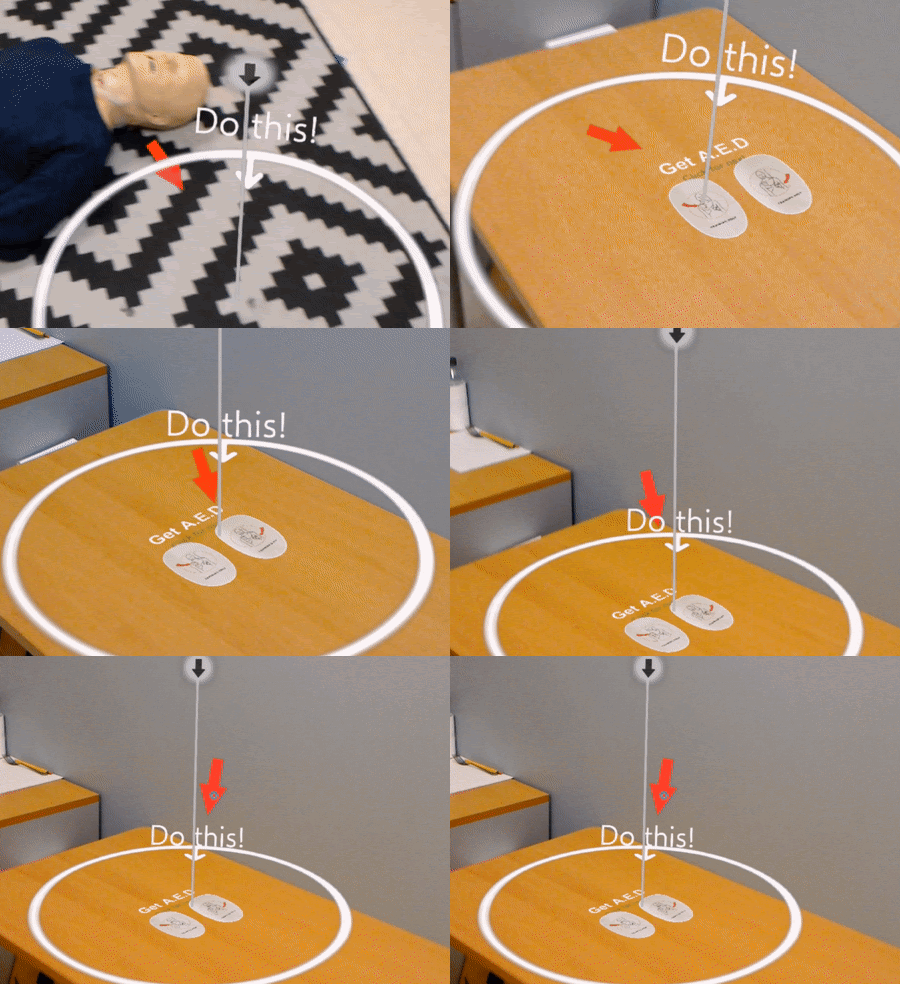
- Circle of Attention: A composite visual anchor (a white circle with a perimeter arrow, text prompts, and images) that draws the eye to the right place in 3D space, even during the erratic movements of chest compressions
- Red Arrow: A gaze-following arrow that directs users toward the next instruction when they need to shift attention away from the patient (e.g., to locate the AED across the room)
- Vertical Pole: An upward-extending line inside the circle that compensates for the HoloLens's narrow field of view, prompting users to tilt their heads rather than just their eyes
- Clicker navigation: We taped a physical clicker to the side of the headset after discovering that users overwhelmingly expected the device to "just know" when they finished a step, even after being explicitly told it wouldn't
Key Findings
We ran a between-subjects study with 42 participants, graduate and undergraduate students across nine departments, most with no HoloLens experience and no CPR training. Everyone played RoboRaid (a mixed reality shooting game) for 12–15 minutes first so the headset's weight and clicker would feel familiar. Then we put them alone in a room with a simulation mannequin hooked up to a mock heart monitor. When the alarm went off, they had to resuscitate the patient using either HoloCPR or a tablet showing the standard Red Cross checklist.
The results were clear. HoloCPR users responded significantly faster, reaching the patient in about 7 seconds compared to nearly 12 seconds for tablet users. They transitioned between steps more quickly (3.2 vs. 4.7 seconds on average) and were twice as fast placing AED pads on the chest (9 vs. 19 seconds). Procedural adherence improved too: only 1 HoloCPR user deviated from the 7-step protocol, compared to 3 tablet users who performed extra rounds of compressions or breaths. And while just 12.5% of tablet users started chest compressions with correct hand form, 41% of HoloCPR users did — with another 30% self-correcting mid-procedure.
Participants told us the difference was about knowing, not just reading. One non-CPR-trained user said the spatial cues were key: "Telling me where and how I had to hold my hands and telling me where the CPR device was, made it super intuitive." Another reflected: "The system told me what to do — otherwise, I would have no idea."
When Users Trust AR Too Much — and Not Enough
Perhaps the most striking findings were about trust. During our iterative design sessions, the HoloLens suffered a catastrophic tracking failure: virtual imagery skewed meters to the side. One participant jumped under a nearby table to continue performing chest compressions on nothing, following the misplaced hologram rather than looking at the actual mannequin. Others blindly followed the red arrow even when the AED was already in plain sight.
On the other end of the spectrum, one participant deliberately placed defibrillator pads in a different position than the hologram instructed. When we asked why, they said they simply couldn't trust the headset to show them exactly what to do. These two extremes (blind compliance and active rejection) pointed to a deeper design challenge around attention bias in AR that would inform our future work.
Interestingly, registration accuracy was often good enough. The HoloLens occasionally placed instructions a few centimeters off from the mannequin's chest, but users could still follow them. It turns out you don't need pixel-perfect alignment to push hard on someone's sternum; you just need the instruction in roughly the right place.
Publications
Johnson, J., Gasques, D., Gubbala, M., & Weibel, N. (2018). HoloCPR: Designing and evaluating a mixed reality interface for time-critical emergencies. Proceedings of PervasiveHealth 2018.
Gasques, D., Johnson, J., & Weibel, N. (2018). Realtime guidance for cardiopulmonary resuscitation in mixed reality. PervasiveHealth 2018 (Demo).
Team
Janet Johnson, Ph.D., Danilo Gasques, Ph.D., Madhuri Gubbala, Nadir Weibel, Ph.D.